
The History and Evolution of Abacus Education: A Look at the History of Abacus Learning

The abacus is one of the oldest tools used for calculation. It has played a significant role in education, especially in teaching children basic arithmetic. Over time, abacus education has evolved, adapting to new teaching methods and technologies. This post explores the history and evolution of abacus education, highlighting its importance and how it has changed.
The History of Abacus Learning
The abacus dates back thousands of years. It was first used in ancient Mesopotamia around 2300 BC. Early versions were simple boards with grooves or lines where stones or beads were placed to represent numbers. The tool spread to different cultures, including the Chinese, Japanese, and Romans, each developing their own versions.
In China, the abacus, known as the suanpan, became widely used by the 2nd century BC. It had two beads on the upper deck and five on the lower deck. This design allowed for efficient calculations. The Japanese soroban, a simplified version with one bead on the upper deck and four on the lower, was developed later and is still used today.
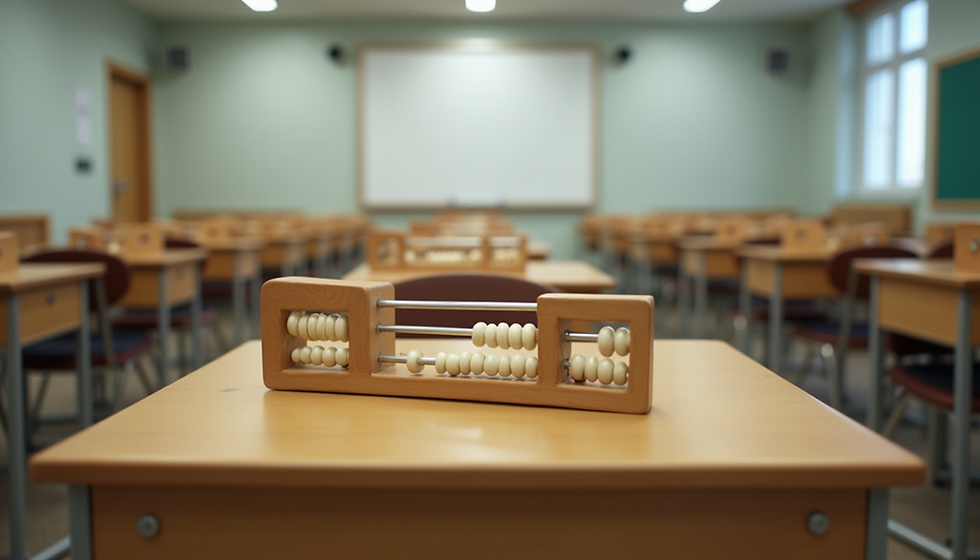
Abacus education began as a practical skill for merchants and traders. Over time, it became a teaching tool in schools to help children understand numbers and arithmetic operations. The method of teaching with the abacus focused on visualising numbers and performing calculations mentally.

The development of abacus schools helped formalise this education. These schools taught children how to use the abacus effectively, improving their speed and accuracy in calculations. The abacus school history shows how these institutions spread across Asia and later to other parts of the world.
How Abacus Education Has Evolved
Abacus education has changed significantly over the centuries. Initially, it was a manual skill passed down through apprenticeships and informal teaching. With the rise of formal education systems, abacus learning became part of the curriculum in many countries.
In the 20th century, abacus education saw a revival, especially in Asia. Teachers began to focus not only on manual calculation but also on mental arithmetic. Students were trained to visualise the abacus in their minds and perform calculations without the physical tool. This method improved concentration, memory, and numerical skills.
Modern abacus education combines traditional techniques with new teaching methods. Many schools and tuition centres use interactive tools and software to engage students. These tools simulate the abacus and provide instant feedback, making learning more effective.
Parents are encouraged to support their children’s abacus learning at home. Simple exercises like daily practice and mental calculation games can help reinforce skills. This approach builds confidence and a strong foundation in maths.

Why Did We Stop Using the Abacus?
The use of the abacus declined in many parts of the world with the invention of electronic calculators in the 1970s. Calculators made arithmetic faster and more accessible, reducing the need for manual tools like the abacus.
Schools shifted their focus to teaching calculator skills and computer-based maths. The abacus was seen as outdated and less relevant in a digital age. This change led to a decrease in abacus education in many Western countries.
However, the abacus did not disappear entirely. In some regions, especially in Asia, it remained popular due to its educational benefits. The mental arithmetic skills developed through abacus training are valuable for cognitive development.
Today, there is renewed interest in abacus education. Parents and educators recognise its role in improving mental maths, concentration, and problem-solving skills. The abacus is now seen as a complementary tool rather than a replacement for modern technology.
Practical Benefits of Abacus Education for Children
Abacus education offers several practical benefits for children. It helps develop a strong understanding of numbers and arithmetic operations. Using the abacus encourages active learning and engagement.
Some key benefits include:
Improved concentration: Learning to use the abacus requires focus and attention to detail.
Enhanced memory: Mental calculation exercises strengthen memory skills.
Better problem-solving: Children learn to approach maths problems logically.
Increased confidence: Mastering abacus skills boosts self-esteem in maths.
Foundation for advanced maths: Early abacus training supports future learning in maths and science.
Parents can support their children by encouraging regular practice and providing access to quality abacus education. Many tuition centres in Melbourne offer specialised abacus and mental maths programs designed for primary and high school students.
The Future of Abacus Education in Melbourne
Abacus education continues to evolve with new teaching methods and technology. In Melbourne, there is growing interest in combining traditional abacus skills with modern educational tools.
Tuition centres are expanding their offerings to include mental maths, English, and general maths tuition. This integrated approach helps children develop a broad range of skills needed for academic success.
For parents looking to support their children’s learning, choosing a provider that offers comprehensive abacus education is important. Such programs focus on building strong numerical skills and confidence, which are essential for school and beyond.
The future of abacus education lies in blending tradition with innovation. By doing so, it can remain a valuable part of children’s education in Melbourne and beyond.

Abacus education has a rich history and continues to offer practical benefits. Understanding its evolution helps appreciate its role in developing strong maths skills. With the right support, children can gain confidence and excel in their studies through abacus learning.

Comments